


Published in the Winter 2008 IBCA Journal and written by:
- John Brown #831
- LaDonna Brown #831A
- Jean Bear #622
- Peggy French #31
Several collectors, beginning with Mark and Joyce Brown at the
2006 Tulsa brick swap, have expressed interest in seeing a
photographic listing of sidewalk pavers with patterns on them. Ohio
collectors John and LaDonna Brown, who have an extensive collection
of these bricks, kicked off the project by having the daughter of
their daughter-in-law, Terri Cooper, of Columbus, take pictures of
their patterned sidewalk pavers.
To these, we have added others. Many of these bricks are
difficult to attribute to particular brick plants with any degree
of accuracy, so we plan to list them simply by number. As
information about the bricks becomes available, we will publish a
list of the numbers, and the source of the bricks, if it is known.
According to the theory of Rev. John Lloyd Evans, Ohio sidewalk
bricks could be traced to three plants by their patterns. "Ohio
Sidewalk Bricks," published in the Summer 1986 issue of the IBCA
Journal, states this theory: A circle on the face of the brick
denotes the Diamond plant. A star design shows that the brick is
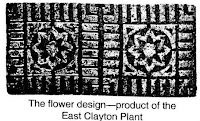
from Nelsonville, and a flower motif tells of manufacture at East
Clayton, where the plant burned in 1892 and was never rebuilt.
However, some of our collectors, including the late Bill Belhorn,
have found indications that designs may have been shared and made
in various locations.
We hope that our membership will enjoy this set of photos, and
will add to the listing by sending in photos or information about
the bricks. Please send your photos to Peggy for future publishing
in another installment.
Reprint of the 1986 article follows.
Ohio Sidewalk Bricks
Early in their careers all fledgling brick collectors should
give serious thought to spending a week or so hunting brick in
southeastern Ohio. Name brands found in that area's dumps and
landfills are seemingly endless and varieties abound. And for those
who are particularly attracted to sidewalk pattern brick, the trip
will be well worth the trouble. They are virtually everywhere.
The Ohio reverend, John Lloyd Evans, in his historical pamphlet
published for the bicentennial celebration, devotes considerable
space to the varieties of sidewalk brick found in and around the
Nelsonville and Logan areas. He estimates that there are ten miles
of such sidewalks still left in that part of Ohio.
According to Rev. Evans, the major design patterns that occur
on Ohio sidewalk brick can be traced to three separate
plants.
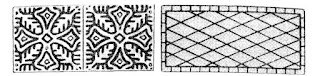
A circle on the face of the brick denotes manufacture at the
Diamond plant; a star design shows that it is a product of the
Nelsonville plant; a flower motif tells of very early production at
the East Clayton plant, which burned to the ground in 1892, never
to be rebuilt. Among the oldest of Ohio sidewalk brick still in use
are probably those that feature raised square ridges. The source of
this design is currently unknown.
In the heyday of brick making in the Nelsonville area, five
major plants were eventually dominant. They, at one time or
another, may have all been involved in the production of sidewalk
brick, along with their main product-street pavers. Rev. Evans
states that at periods of peak production, each of these factories
employed in the neighborhood of 120 men. That would mean at times a
total of 600 persons were involved in the brick industry in the
Nelsonville area alone. The majority of these workers were
immigrants from England, Scotland, Wales, and Ireland. They came
seeking work in the coal fields of western Pennsylvania but
switched to ceramic production when that industry began to
flourish. Some were skilled clay artisans, experienced in the
techniques of clay mixing, molding, and kiln firing. Their talents
were found to be in great demand in the new industry.
An interview in a 1968 issue of the Logan, Ohio newspaper
quotes a Mrs. Susan Carter, who had at that time, recently
completed a thesis on the sidewalk bricks of Ohio. Speaking in
regard to those bricks, Mrs. Carter had this to say:
"Their unique patterns seem quite simple, but like the
dimensions of the Parthenon, they have some surprises. Each brick
exhibits two identical patterns side by side. At first glance these
enclosing patterns look like squares, but they are in fact
rectangles, with longitudinal sides over a quarter of an inch
longer than the transverse sides.
"The rectangular patterns are composed of ridges-thirteen on a
side in the case of the circle and six-pointed star brick made at
Nelsonville, ten in the case of the eight- pointed star brick, and
twelve in the case of the smaller square brick.
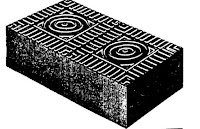
"Within each of these enclosed ridge patterns is a second
enclosing figure which again appears to be a square but is instead
a rectangle, a reduced version of the larger enclosing rectangle.
And within this figure is the dominant motif, either circle
(actually four concentric circles), square or star. The
eight-pointed star has a portion of a sphere in its center and is
surrounded by a circle.
"Close examination of the manner in which each of the four
patterns is executed with intersecting ridges and furrows will
reveal the fact that the designs are much more sophisticated than
they appear on first sight.
"This leads one, then, to the ostensibly puzzling question: why
do these bricks have any designs at all? For hundreds of years
walkways have been constructed of ordinary un-patterned brick; why
should brick with circles, stars and squares appear in the U.S. in
the late nineteenth century? And why are they both vitrified and
glazed?
"The answers to such questions can be formulated only by
returning for a moment to the history of the Ohio brick making
industry, specifically to that of Nelsonville. Exactly when and in
what plant the first vitrified, salt-glazed pattern brick were
produced is not known. Certain of their features indicate that the
original models were not designed for sidewalks, but were later
shifted to that application. For example, glazing as a means of
improving the durability of sidewalk or even pavement brick is a
some-what dubious proposition. Almost completely vitrified, their
absorption rates are so low-on the order of two percent-that the
application of salt-glaze over some or all of their surfaces does
not make much difference in their ability to repel moisture.
"However, glazing with lead, manganese and iron for decorative
purposes was becoming a popular practice in the Ohio brick making
industry by the year 1884. Relatively new to industrial
application, these compounds enabled manufacturers to produce
bricks with different colored faces, for use primarily in homes and
business structures.
"Glazing, then, was something of a fad at about the time
pattern brick were first produced. Yet salt-glazing, the cheapest
and simplest of all glazing methods, and known to ceramics workers
since colonial times, was still very popular.
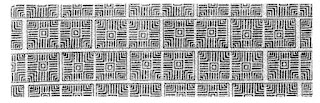
"These conditions set the stage for the appearance of
vitrified, salt-glazed, patterned brick. These were first
introduced as a surface for packinghouse floors.
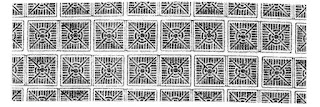
"In the 1880s and 1890s, under the guidance of men like Armour
and Swift, the slaughtering and meatpacking business grew to
immense proportions. As is true even today, a great deal of
handwork is involved in this trade, and, to speak plainly, a great
deal of blood and gore. To control such elements, and to check the
possible spread of disease, slaughterhouse designers turned to the
vitrified, salt-glazed, pattern brick. Such brick had to have the
lowest possible absorption percentage, and in this instance it was
evidently concluded that salt-glazing was worthwhile. In addition,
the patterns impressed upon the brick would provide increased
traction for the feet of men working on slippery slaughterhouse
floors.

"Vitrified, self-glazed pattern brick lent itself to sidewalk
construction for at least three reasons. First, sidewalk traffic
bears very little weight; the much thicker pavers would be out of
place in a sidewalk, but the thinner brick created a substantial
surface without wasting material. "Second, the imprinted patterns
provided a good walking surface even in wet weather. Third, the
glazed surfaces of such brick were easy to clean.
"To these three practical reasons might be added a fourth: the
patterns on the bricks were aesthetically attractive. They provided
a kind of semi-abstract, decorative beauty common to the late
nineteenth century, and they provided that beauty to an everyday
urban landscape that was being increasingly darkened by industrial
smoke.

"In this respect, the brick designs are related to the
"gingerbread" and scroll-saw carpentry work then popular and the
ornamental iron railings found on the most representative houses of
the period. Such late Victorian decoration was occasionally
pointless or redundant, not structurally essential, and in some
instances nothing more than ostentation.
"The pattern brick designs, however, are inseparable from their
function that of providing a good walking surface. They integrated
both utility and aesthetic quality in a very direct, honest way."

Mrs. Carter's remarks conclude with the statement that, all
things considered, it is her opinion that sidewalk pattern bricks
rank with some of the best designed objects of their era. A good
many IBCA members would probably agree.
Additional information from the IBCA Facebook group:
Ed Wagner: we found an advertisement in a roads journal for
a company that made the machines to make these and it appears that
numerous companies may have had the same machines and made
identical bricks.